The Danger of the Nodding Room, Understanding the Asch Conformity Effect
Have you ever sat in a meeting, disagreed with what was being said, but said nothing? Have you ever watched a decision unfold that did not feel right, but assumed everyone else must know something you do not?
When the room agrees too easily
You are not alone, you are not weak. You are human.
What you experienced has a name, and understanding it could be one of the most valuable things an HR professional or people leader does this year.
What Is the Asch Conformity Effect?
In the 1950s, psychologist Solomon Asch conducted a series of now-famous experiments to understand the power of social pressure on individual judgement.
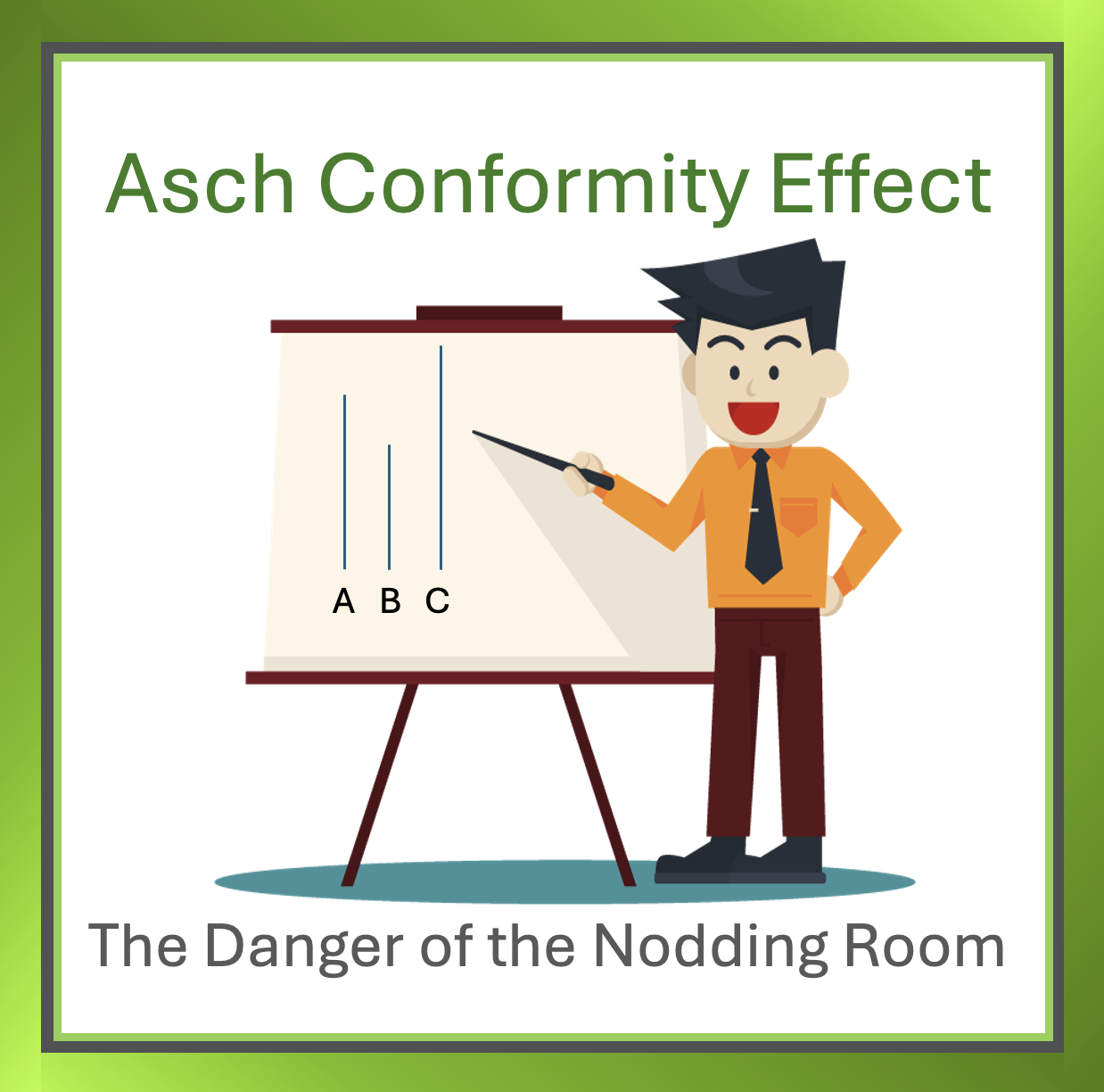
Participants were shown a line on a card and asked to match it to one of three other lines of clearly different lengths. The answer was obvious. Under normal conditions, people got it right almost every time.
But here was the twist.
Each participant was placed in a group where everyone else was an actor, secretly instructed to give the wrong answer. When the group confidently stated the incorrect answer, a significant number of real participants went along with it, even though they could see with their own eyes that it was wrong.
Around 75% of participants conformed at least once. Many did so repeatedly.
Not because they were foolish. Not because they lacked confidence in isolation. But because the social pressure of the group overrode their individual judgement.
Why This Matters in the Modern Workplace
Asch’s experiment used lines on a card. Your organisation uses strategy decisions, performance reviews, hiring choices, culture-setting conversations, and leadership behaviours.
The stakes are considerably higher.
Conformity in the workplace is not always dramatic. It rarely looks like someone being forced to agree. More often, it is quiet. Subtle. It looks like:
- A senior leader shares a view in a meeting and the room immediately aligns
- A team agrees to a plan in the room, then picks it apart in the corridor afterwards
- Concerns about a decision go unvoiced because nobody else seems to be raising them
- A new employee quickly learns what opinions are welcome and adjusts accordingly
- A performance issue goes unaddressed because everyone assumes it is acceptable if nobody is challenging it
This is the nodding room and most organisations have one.
The Organisational Cost of Conformity
When people conform rather than contribute their genuine thinking, organisations pay a real price.
- Poor Decision Making
When dissenting voices stay silent, decisions are made on incomplete information. The group believes it has consensus when it actually has compliance. The result is strategies built on blind spots.
- Groupthink
Conformity and groupthink are close relatives. When teams prioritise harmony over honesty, they stop stress-testing ideas. Risks go unidentified. Opportunities get missed. And when things go wrong, everyone wonders why nobody said anything.
- Erosion of Psychological Safety
When people learn that speaking up leads to social discomfort, being the odd one out, being seen as difficult, they stop speaking up. Over time, this becomes the culture. Not through one defining moment, but through dozens of small surrenders.
- Loss of Diverse Thinking
Organisations invest significantly in building diverse teams. But diversity of thought only delivers value if people feel safe to express it. Conformity pressure silences exactly the perspectives that diversity is meant to surface.
Where Conformity Hides in HR Processes
The Asch effect is not just a meeting room phenomenon. It appears throughout the employee lifecycle in ways that are worth examining:
- Recruitment and Hiring
Panel interviews where one strong voice steers the group. Candidate assessments that converge around the most senior person’s first impression. Hiring decisions that favour people who seem to “fit”, often meaning they are unlikely to challenge the status quo.
- Performance Reviews
Calibration sessions where initial ratings shift to match the dominant view in the room. Managers who moderate their feedback to align with what others have said, rather than what they genuinely observed.
- Culture and Values
Engagement surveys where people score things more positively than they feel, because they are unsure whether honest responses are truly anonymous or truly welcomed.
- Leadership Meetings
The higher up the organisation you go, the more powerful conformity can become. Senior leaders are often surrounded by people who have learned, over time, that agreement is safer than challenge.
What HR and People Leaders Can Do
Understanding the Asch effect gives people leaders a framework for building something more valuable than agreement. It gives them a framework for building genuine voice.
- Design for Dissent
Do not just ask for feedback, create structures that make it easier to give. Anonymous surveys, pre-meeting written submissions, and deliberate devil’s advocate roles all reduce the social pressure that conformity thrives on.
- Watch Who Speaks First
In group discussions and decision-making meetings, the first opinion shared carries disproportionate influence. Consider asking people to form and share their views independently before group discussion begins. This is sometimes called a pre-mortem approach and it consistently surfaces better thinking.
- Reward Challenge, Not Just Agreement
If the only visible career reward is alignment with leadership, people will align. Actively recognise and celebrate moments where someone respectfully challenged a direction, asked a difficult question, or raised an uncomfortable truth, especially when they were right to do so.
- Build Psychological Safety Intentionally
Psychological safety does not happen by accident. It requires leaders to model vulnerability, respond well to challenge, and demonstrate consistently that honesty is more valued than comfort. This is a leadership behaviour issue as much as a culture one.
- Revisit Your Meeting Culture
How many of your meetings are genuinely collaborative versus performatively so? Consider smaller group discussions, rotating who leads the conversation, and creating explicit space for concerns before decisions are finalised.
- Train Managers to Spot Conformity
Managers who understand the Asch effect are better equipped to notice when their teams are performing agreement rather than genuinely engaging. This awareness alone can change how they facilitate conversations and respond to silence.
The Human Side of This
It is important to say this clearly: conforming is not a character flaw. Asch’s research showed that the desire to fit in, to avoid social friction, to not be the person who disrupts the harmony of the group, these are deeply human instincts.
But in professional settings, acting on those instincts unchecked carries a cost. Not just to the organisation, but to the individual. People who regularly suppress their genuine views in the workplace report lower engagement, lower job satisfaction, and a diminished sense of professional identity.
When we build cultures where honest voices are welcomed, we are not just improving organisational performance. We are giving people permission to show up as themselves.
Final Thought
Asch’s participants were not stupid. They could see the right answer. But the weight of social expectation was heavier than the evidence in front of them.
Look around your organisation. Where are people seeing one thing and saying another? Where is the room nodding when it should be questioning?
The most valuable voice in any team is often the one that has not yet felt safe enough to speak.