
Why People Stop Trying at Work – The Pike Effect
In many workplaces, when people stop speaking up, stop applying for opportunities, or stop volunteering ideas, the first assumption is often that they have become disengaged or unmotivated.
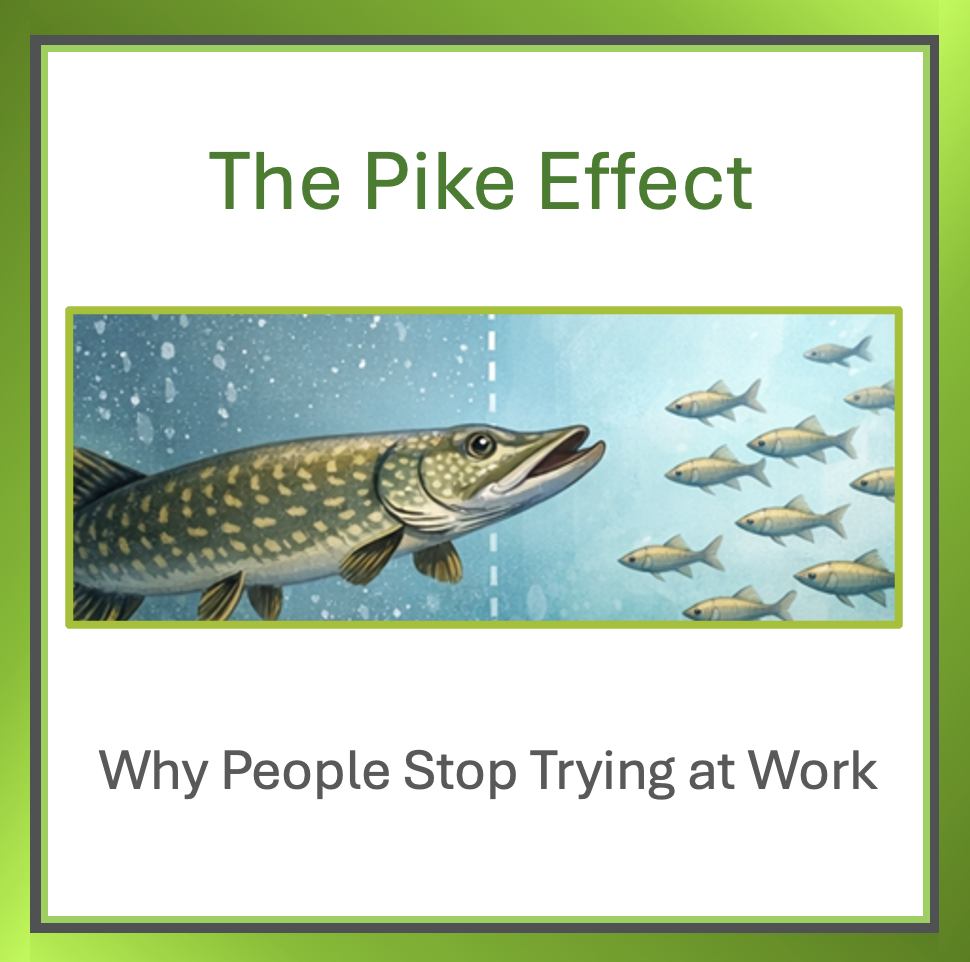
The barrier does not have to still be there for it to still be felt
But that is not always the full story.
Sometimes, employees stop trying because experience has taught them that trying will not make a difference. This is where the Pike Effect becomes a useful metaphor for HR.
What is the Pike Effect?
The Pike Effect, sometimes called Pike Syndrome, is a way of describing learned helplessness, when someone gives up because they have been conditioned to expect failure or resistance.
The idea is often illustrated through a well-known story about a pike placed in a tank with smaller fish, separated by a transparent glass barrier. Each time the pike tried to reach the fish, it hit the glass. Eventually, it stopped trying. In later versions of the story, even when the barrier was removed, the pike still did not attack because it had learned that the effort was pointless.
While the story itself is often shared as a metaphor rather than a piece of rigorous modern science, the workplace lesson is still powerful, past setbacks can create invisible barriers that shape future behaviour.
Why does this matter in HR?
For HR professionals, the Pike Effect helps explain why employees do not always respond to new opportunities, encouragement, or change in the way leaders expect.
A person may have the ability, ambition, and ideas to contribute, but if they have repeatedly experienced dismissal, bias, lack of recognition, or unclear pathways, they may start to hold back. Over time, this can look like:
- staying quiet in meetings
- avoiding new responsibilities
- not applying for internal roles
- withdrawing from development opportunities
- hesitating to challenge poor decisions
- becoming passive during change initiatives
What appears to be low motivation may actually be learned discouragement.
How the Pike Effect shows up at work
The Pike Effect can affect individuals, teams, and even entire organisations.
- Employee voice disappears
If people share ideas and hear nothing back, they often stop speaking up. Silence can quickly become part of the culture.
- Internal mobility drops
When promotion or progression feels unclear, inconsistent, or biased, employees may stop applying, even when strong opportunities become available.
- Innovation slows down
If new suggestions are routinely dismissed with “we’ve tried that before” or “that’s not how we do things,” teams can become stuck in old patterns.
- Confidence declines
Repeated setbacks can affect self-belief. Employees may begin to doubt their own ability, even when they are capable and ready.
- Change fatigue increases
When employees have lived through repeated change programmes that promised improvement but delivered little, they may stop engaging with future initiatives. This can be mistaken for resistance, when in reality it is often a sign of disappointment and fatigue.
What creates this pattern?
The Pike Effect does not usually come from one single event. It builds over time through repeated experiences such as:
- ideas being ignored
- inconsistent management decisions
- unfair treatment
- unclear expectations
- lack of feedback
- broken promises
- poor communication during change
- limited access to development or progression
When these experiences stack up, employees can start to protect themselves by lowering effort, reducing visibility, or avoiding risk.
What can HR do about it?
The good news is that learned discouragement can be reversed, but only if the workplace gives people a reason to believe that effort matters again.
- Close the feedback loop
If employees raise ideas, concerns, or questions, respond to them. Even when the answer is no, explaining why shows that speaking up has value.
- Make opportunity pathways visible
Career progression, internal vacancies, learning opportunities, and promotion criteria should be clear and accessible. If people do not understand how to move forward, they are less likely to try.
- Train managers to respond well
Managers have a huge influence on whether people keep contributing or withdraw. Dismissive, inconsistent, or overly critical responses can reinforce helplessness very quickly.
- Create small wins
Confidence is often rebuilt through evidence. Giving employees meaningful opportunities to contribute and succeed can help challenge the belief that effort is pointless.
- Pay attention to patterns, not just performance
If someone who was previously proactive becomes quiet or hesitant, it is worth asking what has changed. Behaviour often tells a story that performance data alone cannot.
- Build psychological safety
People are more likely to try, suggest, challenge, and grow when they believe they can do so without embarrassment, punishment, or unfair consequences.
- Be consistent
Few things reinforce helplessness more than unpredictability. Fair, transparent, and consistent people practices help restore trust.
Questions HR leaders should be asking
To spot the Pike Effect early, organisations should ask:
- Do employees believe their voice leads to action?
- Do people trust the fairness of promotion and development decisions?
- Are managers encouraging initiative or unintentionally shutting it down?
- Have past change efforts damaged trust?
- Are quiet teams truly engaged, or have they simply stopped expecting improvement?
These questions can reveal whether a motivation problem is actually a trust problem.
Final thought
When employees stop trying, it is tempting to ask, “What is wrong with them?”
A better question is, “What has their experience taught them?”
The Pike Effect reminds us that people do not always disengage because they do not care. Sometimes they disengage because they cared, tried, and learned that it did not matter.
For HR, that distinction matters.
Because if discouragement has been learned, it can also be unlearned, through fairness, consistency, psychological safety, and visible proof that effort leads somewhere.