
The Promotion Trap, Understanding the Peter Principle in the Workplace
Imagine your best salesperson. They consistently hit targets, build brilliant client relationships, and seem to make it look effortless. So when a sales management role becomes available, promoting them feels like the obvious decision.
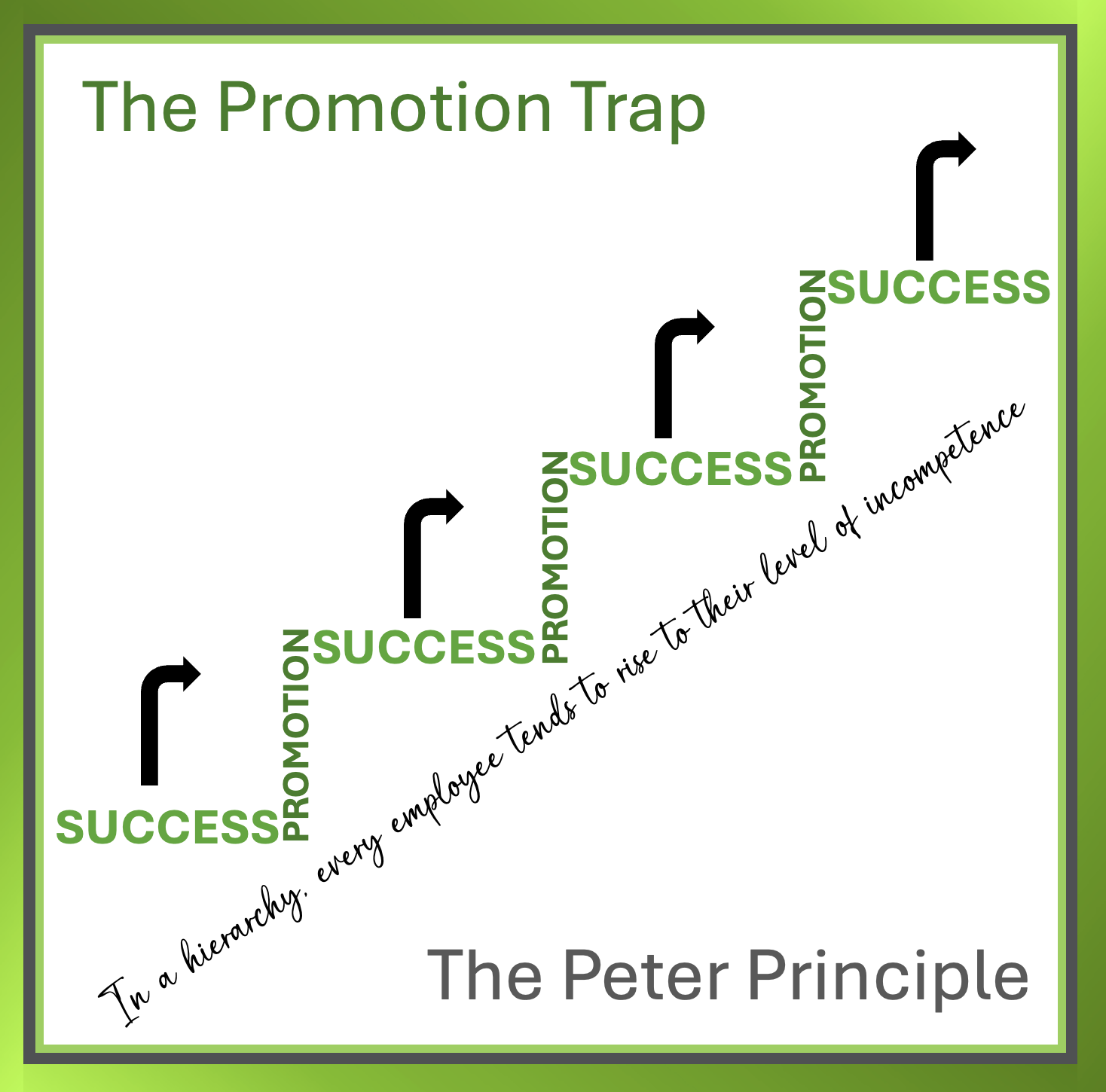
Climbing the ladder feels like progress. But without the right support and the right assessment, the next rung can become the highest someone was ever meant to go.
Twelve months later, the team is struggling. Your star performer is overwhelmed. The skills that made them exceptional in their previous role are not the skills the new role demands. And now you have lost a great salesperson and gained a manager who is not yet equipped to lead.
This is not an unusual story. It has a name.
What Is the Peter Principle?
In 1969, researcher and educator Laurence J. Peter introduced a concept that was equal parts humorous and deeply uncomfortable for organisations to sit with.
His observation, drawn from studying hierarchical structures, was this:
In a hierarchy, every employee tends to rise to their level of incompetence.
The logic is straightforward. When someone performs well in their role, they get promoted. They perform well again, so they get promoted again. This continues until they reach a role in which they are no longer effective. At that point, promotions stop and the organisation has permanently placed someone in a job they are not suited for.
The Peter Principle is not about people being incompetent in general. It is about organisations promoting people based on past performance rather than future capability.
And it happens constantly.
Why This Still Matters Over Fifty Years Later
You might expect that modern HR practices, competency frameworks, and leadership pipelines would have largely solved this problem by now.
They have not.
The Peter Principle persists because the conditions that create it are deeply embedded in how most organisations think about reward, recognition, and progression.
When someone excels, promoting them feels natural. It feels fair. It feels like the right thing to do. And in many cases, it genuinely is the right move when it is done thoughtfully, with the right support and the right assessment of future potential.
But too often, promotion is used as:
- The primary way to reward high performance
- A retention tool when someone is at risk of leaving
- A signal of trust and appreciation
- A default next step, rather than a deliberate career decision
When promotion becomes a reflex rather than a considered decision, the Peter Principle is given room to operate.
What It Looks Like in Practice
The Peter Principle shows up across industries, functions, and seniority levels. Here are some of the most common patterns:
The Technical Expert Turned Manager
An engineer, analyst, accountant, or specialist is exceptional at their craft. They are promoted into a people management role as recognition of that expertise. But managing people requires an entirely different skill set, coaching, conflict resolution, delegation, emotional intelligence, strategic thinking. Without development in these areas, the transition is hard and sometimes damaging for both the individual and their team.
The Top Performer Who Cannot Delegate
In an individual contributor role, doing everything yourself is often what makes you brilliant. In a leadership role, it becomes a bottleneck. Some promoted individuals struggle to let go of the work they were rewarded for, leading to micromanagement, team frustration, and burnout.
The Relationship Builder Who Cannot Hold Accountability
Some people are promoted because they are universally liked, trusted, and respected. These are genuine strengths. But leadership also requires difficult conversations, fair challenge, and consistent accountability. Without the confidence or skills to do that, teams can drift and performance can slide.
The Senior Leader Who Has Outgrown Their Depth
The Peter Principle does not only apply to first-time managers. It can occur at every level of an organisation. A director who was an exceptional head of department. A CEO who was a brilliant COO. Each step up the ladder requires different capabilities, and reaching the next level does not guarantee readiness for the one after that.
The Organisational Cost
When the Peter Principle takes hold, the consequences ripple outward.
For the individual, being placed in a role beyond their current capability without adequate support can damage confidence, increase stress, and ultimately lead to disengagement or departure.
For the team, being managed by someone who is not yet effective in their role affects morale, performance, direction, and trust. Teams notice when leadership is uncertain. They feel the gap.
For the organisation, poor leadership decisions multiply. Disengaged managers create disengaged teams. High performers leave. Succession pipelines weaken. And the original problem, how to reward and retain your best people, remains unsolved.
There is also a subtler cost. When the Peter Principle becomes visible in an organisation, it sends a message to everyone watching:
Progression here is about who you are today, not whether you are ready for tomorrow.
That is a difficult message to undo.
The Root Cause: Conflating Performance With Potential
At the heart of the Peter Principle is a confusion between two very different things:
Performance is how well someone executes the responsibilities of their current role.
Potential is how well someone is likely to perform in a future, more complex role.
These are related but they are not the same thing. High performance in a role is a positive indicator, but it does not automatically predict success at the next level, particularly when the nature of the work changes significantly.
Organisations that rely solely on past performance data to make promotion decisions are making predictions about the future using the wrong evidence.
What HR and People Leaders Can Do
The Peter Principle is not inevitable. It is a product of system design, and it can be addressed through more intentional people practices.
- Separate Reward from Promotion
If promotion is the only meaningful way to reward high performance, organisations will over-promote. Building strong recognition frameworks, financial, developmental, and cultural that do not require a title change gives organisations more flexibility and reduces pressure to promote prematurely.
- Assess for Future Role Requirements, Not Just Past Results
Promotion decisions should include an honest assessment of whether the individual has or can develop the capabilities the new role demands. Competency frameworks, structured interviews, and assessment tools focused on the target role are far more reliable than performance ratings alone.
- Invest in Transition Support
Even the right promotion can go wrong without the right support. Structured onboarding into a new level of leadership, coaching, mentoring, and regular check-ins during the transition period significantly improve the chances of success.
- Create Expert Career Pathways
Many organisations only offer one direction for progression, upward into management. But not everyone who is excellent at their craft wants to manage people, and not everyone should. Building technical or specialist career tracks that offer seniority, recognition, and reward without requiring a move into people management retains expertise where it belongs.
- Have Honest Conversations About Readiness
HR and line managers should be equipped to have genuine, supportive conversations with high performers about their career aspirations and their readiness for the next step. This includes being honest when someone is not yet ready and building a plan to get them there.
- Review Your Succession Planning Process
Succession planning should not simply identify who is performing well today. It should assess who is developing the capabilities needed for future roles and invest in building those capabilities deliberately over time.
- Normalise Lateral Moves
In many organisations, a lateral move is still perceived as a failure or a step backward. Shifting that perception and actively valuing breadth of experience can open up better pathways for individuals and reduce the pressure to promote upward before someone is ready.
A Note on Compassion
It is important to acknowledge that when the Peter Principle plays out, the person most affected is often the individual who was promoted with the best of intentions.
They were not set up to fail deliberately. They were recognised, rewarded, and trusted, and then placed in a role without the right preparation or support.
When someone is struggling in a promoted role, the instinct can be to question their capability or commitment. But the more useful question is whether the organisation gave them what they needed to succeed before, during, and after the transition.
The Peter Principle is rarely a people failure. It is almost always a process failure.
Final Thought
Promoting your best people feels like good leadership. And it can be when it is done thoughtfully, with the right assessment, the right development, and the right support.
But when promotion becomes a reward for yesterday’s performance rather than a decision about tomorrow’s fit, organisations quietly build layers of misplaced talent.
The solution is not to stop promoting people. It is to promote them for the right reasons, at the right time, with the right investment behind them.
Because your best people deserve more than a title. They deserve to succeed in it.
At Tick HR Solutions, we support organisations to build fairer, more effective approaches to succession planning, promotion decisions, and leadership development. If you would like to talk about how your organisation manages progression, we would love to hear from you.