
The Confidence Gap: Understanding the Dunning-Kruger Effect at Work
Have you ever sat in a meeting with someone who spoke with absolute certainty about a topic they clearly did not fully understand? Or worked alongside someone deeply skilled and experienced who constantly questioned whether they were good enough?
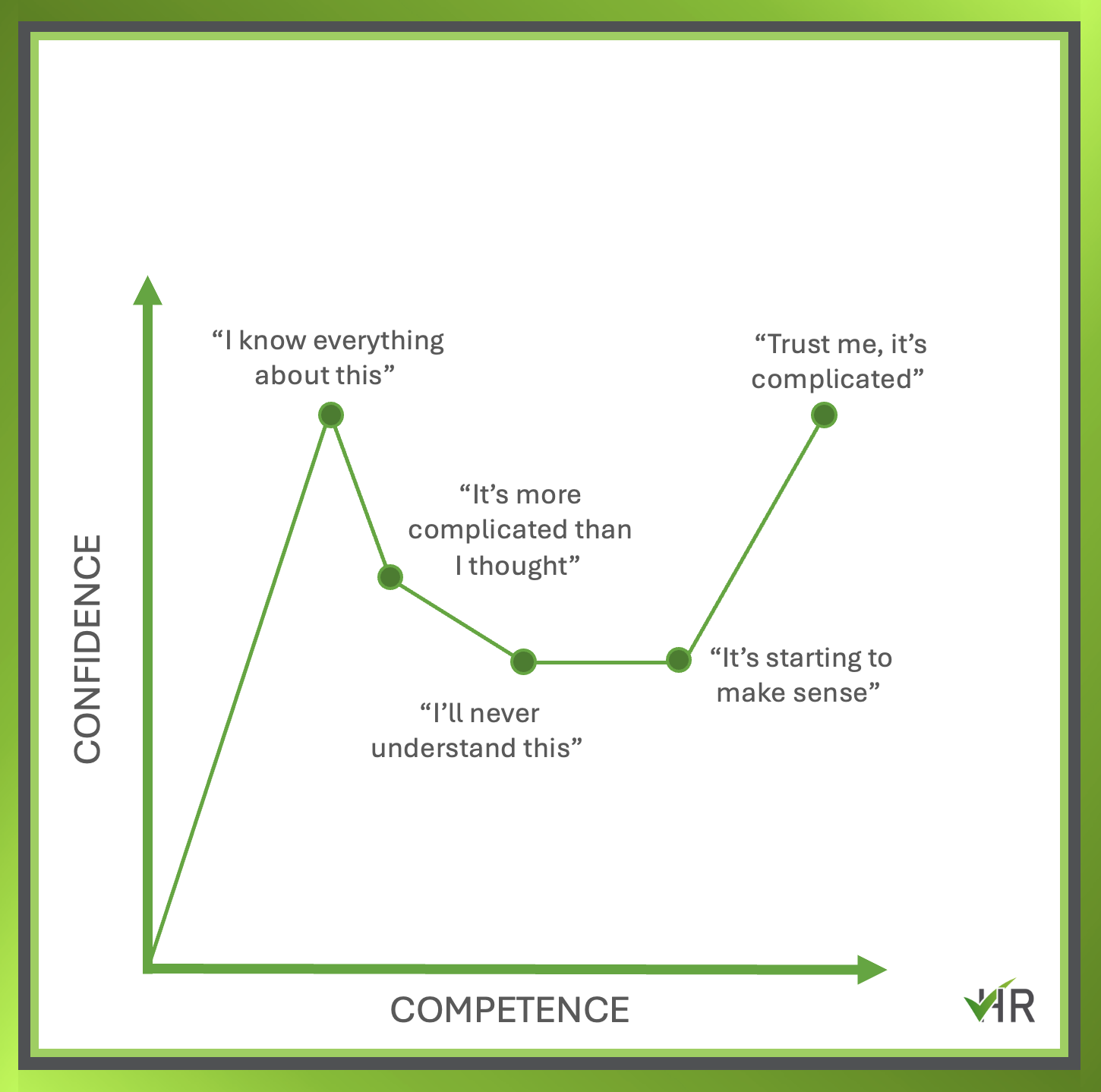
The Dunning graph reveals the Confidence Gap—overconfident novices vs. humble experts.
Both of these experiences are more than just personality quirks. They are connected by one of the most well-known and widely discussed phenomena in psychology.
And both have significant implications for how organisations hire, develop, promote, and lead their people.
What Is the Dunning-Kruger Effect?
In 1999, psychologists David Dunning and Justin Kruger published research that would go on to become one of the most referenced studies in popular psychology.
Their findings, drawn from a series of experiments at Cornell University, revealed a striking pattern:
People with limited knowledge or skill in a given area tend to overestimate their own competence. Meanwhile, people with genuine expertise tend to underestimate theirs.
In one study, participants who scored in the bottom quarter on tests of logical reasoning, grammar, and humour rated their own performance as above average. They lacked not only the ability but also the awareness to recognise their own limitations.
Conversely, those who performed exceptionally well tended to assume that the tasks were straightforward for everyone and therefore underestimated how much their performance stood out.
The result is a pattern that looks something like this:
- Low skill + low awareness = high confidence
- High skill + high awareness = lower confidence
This is not about intelligence. It is about the relationship between knowledge and self-perception, and it plays out in workplaces every single day.
Why Awareness Is the Missing Ingredient
The core insight of the Dunning-Kruger Effect is not simply that some people are overconfident. It is that the skills needed to perform a task well are often the same skills needed to recognise when you are performing it poorly.
In other words, if you do not know enough about something, you do not know enough to know what you are missing.
A new manager who has never experienced truly excellent leadership may genuinely believe their current approach is strong because they do not yet have the frame of reference to see its gaps.
A junior analyst who has learned one methodology may be completely confident in their conclusions because they are not yet aware of how many other methodologies exist and what they might reveal differently.
This is not arrogance in the traditional sense. It is a knowledge gap masquerading as certainty.
How the Dunning-Kruger Effect Shows Up at Work
Once you understand this effect, you will begin to notice it across almost every area of people management and organisational life.
Recruitment and Hiring
Candidates who know a little about a role can sometimes present with more confidence than candidates who know a great deal. The latter understands the complexity, the nuance, the things that can go wrong. The former does not yet know what they do not know and that can read as conviction in an interview room.
Hiring managers who are not aware of this dynamic can inadvertently favour confident presentation over genuine depth, particularly in competency-based interviews where self-assessment plays a significant role.
New Manager Transitions
The early weeks of a management role are a classic Dunning-Kruger environment. New managers who have not yet encountered the complexity of leading people can feel remarkably confident. It is only as the role deepens as difficult conversations arise, team dynamics become complex, and strategic decisions carry real weight, that the genuine challenge of leadership becomes apparent.
This is often described as the dip in the learning curve. It can be a vulnerable moment if organisations do not provide the right support and framing.
Performance Reviews and Self-Assessment
Self-appraisal processes rely on employees accurately assessing their own performance. But the Dunning-Kruger Effect tells us that self-assessment is systematically skewed. Lower performers tend to rate themselves more highly than their managers do. Higher performers often rate themselves more critically than the evidence warrants.
This does not mean self-assessment is without value. But it does mean that calibration through honest feedback, structured conversations, and external perspective is essential.
Leadership and Senior Decision Making
The Dunning-Kruger Effect does not only affect junior employees. It can operate at the most senior levels of an organisation. Leaders who have been successful in one context can develop an overconfidence in their ability to navigate very different challenges, new markets, new industries, new organisational cultures.
The higher someone rises, the fewer people around them are likely to offer honest challenge. and the more dangerous unchecked overconfidence becomes.
Learning and Development Engagement
Here is an interesting practical consequence. People who overestimate their competence are often the least likely to engage with development opportunities because they do not believe they need them. The people most likely to show up eagerly to training are often those who are already performing well and are acutely aware of their own gaps.
This creates a development paradox that HR and L&D professionals need to actively design around.
Imposter Syndrome and the Other End of the Scale
The Dunning-Kruger Effect has a mirror image that is equally important for HR to understand. Highly capable people who underestimate their own competence, a pattern closely associated with imposter syndrome can hold back from opportunities, undermine their own contributions, and fail to advocate for themselves in the way their talent deserves.
Organisations lose out when skilled people do not step forward, and individuals suffer when their self-perception is consistently out of step with their actual capability.
The Organisational Cost
When the Dunning-Kruger Effect goes unaddressed, organisations can find themselves with:
- Overconfident voices dominating decisions at the expense of more measured, knowledgeable ones
- Development resources directed at the wrong people because those who need them most do not seek them
- Capable employees held back by self-doubt that has no basis in their actual performance
- Poor hiring decisions driven by confident presentation rather than genuine competence
- Leadership blind spots that go unchallenged because seniority has been confused with expertise
None of these are small problems. Together, they represent a significant drag on performance, culture, and talent retention.
What HR and People Leaders Can Do
The Dunning-Kruger Effect cannot be wished away. But it can be managed through thoughtful people practices and a culture that values honest self-awareness.
- Build Feedback into Everything
Accurate self-perception depends on accurate external feedback. Regular, honest, specific feedback, not just at appraisal time but throughout the year gives people the information they need to calibrate their self-assessment more accurately. This is one of the most powerful tools available against Dunning-Kruger at every level.
- Redesign Self-Assessment Processes
Rather than asking employees to rate their own performance in isolation, structure self-assessment conversations around specific evidence, examples, and outcomes. Evidence-based reflection is more accurate than impression-based rating, and it creates better quality development conversations.
- Train Interviewers to Look Beyond Confidence
Structured interviews with consistent, evidence-based questions and trained interviewers reduce the influence of surface confidence on hiring decisions. Teaching interviewers to probe for depth to ask follow-up questions that test the quality of knowledge behind the confident answer significantly improves decision making.
- Support New Managers Through the Dip
When new managers encounter the complexity of leadership for the first time and their initial confidence gives way to uncertainty, organisations should be ready. Coaching, peer support, structured development programmes, and normalising the learning curve all help people move through this period productively rather than retreating into false confidence or becoming paralysed by self-doubt.
- Create Cultures Where Not Knowing Is Acceptable
In many organisations, admitting uncertainty is quietly punished. People learn to project confidence even when they do not feel it because showing doubt feels risky. Building a culture where saying “I am not sure, let me find out” is respected rather than penalised is one of the most effective ways to reduce the Dunning-Kruger Effect at an organisational level.
- Pay Attention to the Quiet Experts
The highly skilled people who underestimate themselves are often not the loudest voices in the room. Actively seeking out their contributions, creating environments where thoughtful and measured voices are heard, and explicitly recognising expertise that does not come wrapped in confidence are all important leadership behaviours.
- Invest in Metacognitive Development
Metacognition, the ability to think about your own thinking is a learnable skill. Leadership development programmes that include reflective practice, self-awareness tools, 360 feedback, and coached reflection build the internal capacity to spot and manage personal blind spots over time.
A Note on Humility
There is something quietly humbling about the Dunning-Kruger Effect that is worth acknowledging directly.
None of us are immune to it. In every area where our knowledge is limited — and there are always areas where our knowledge is limited we are at risk of not knowing what we do not know.
The most self-aware leaders are not those who have eliminated this tendency. They are those who have learned to hold their own certainty lightly, to stay curious, to welcome challenge, and to recognise that confidence and competence are not the same thing.
Intellectual humility is not a weakness. In leadership, it is one of the most sophisticated strengths there is.
Final Thought
The Dunning-Kruger Effect reminds us that in any room, the most confident voice is not always the most informed one. And the most hesitant voice is not always the least capable.
Building organisations that can tell the difference through better feedback, fairer assessment, and cultures that value depth over display is one of the most valuable things HR and people leaders can invest in.
Because the goal is not just confident people.
The goal is people who know what they know, know what they do not know, and have the self-awareness to tell the difference.
At Tick HR Solutions, we support organisations to build self-aware, high performing cultures through leadership development, coaching, and smarter people practices. If you would like to explore how we can help your organisation get the best from its people, we would love to hear from you.